YOU BLOODY BEAUTY

Updated: Jul 19
Transylvania has a reputation as the dark arts centre of the world. Think vampires, werewolves, witchcraft ... and terrible movies. BILL WATT discovers what this Romanian region is really like.

Mist, rain, sleet and snow ... the perfect conditions for yet another remake of the horror classic, Dracula. But, also the perfect recipe for a visit to the horror story centre of the world ... Transylvania. And, the weather gods did not disappoint when my wife and I embarked on our odyssey to the world of vampires and werewolves.
It all started so predictably, picking up a hire car at Bucharest's Henri Coanda International Airport. So, off we head for Brasov in Transylvania in our rented Dacia Bigster in sunny, dry conditions. But, as we reach the foothills of the Southern Carpathian mountains, things change. The skies darken and snow flurries swirl around us. It's late spring, wtf? For a moment it felt like the road conditions were going to become our rocky horror show.
Well, of course, we made it over the mountains into the picturesque mediaeval town of Brasov, the gateway to Transylvania, with clouds still skulking threateningly overhead.
It was the next morning that the weather really came into its own. The rain teemed down as we made our way to the village of Bran, and “Dracula’s Castle”.
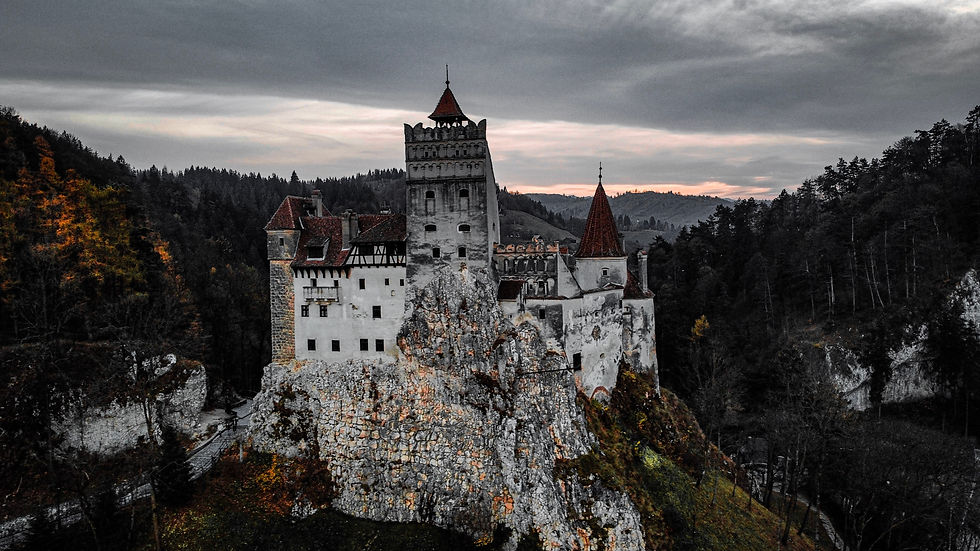
Firstly, a disclaimer: Bran Castle is widely marketed as Dracula’s Castle. It looks like a vampire king’s castle - feels like it, too. But, there are no proven links between the castle and Dracula. There is one theory Vlad Tepes - aka Vlad Dracul, aka Vlad the Impaler, aka Dracula - was once imprisoned in the castle, but more likely that happened somewhere in Hungary. As Maxwell Smart would say: "Missed it by that much"!
But, really, who cares. This is an eerily spooky-looking castle built seven centuries ago that rises high above a small Transylvanian village. If Count Dracula was house hunting, he would take out a mortgage on Bran Castle (with the Blood Bank?).
The castle comes complete with 57 rooms, nooks, crannies, winding corridors, a secret passage, areas dedicated to Romania's royal past, gruesome effigies, a torture chamber and a Vlad Tepes (Dracula) obsession.
As eerie as the castle's interior seemed, it was along the fortress's lofty exterior walkways and terraces that we were transported to the cold, misty world of myth and fairytale. The weather, far from being a burden, had become our adventure's perfect partner. As we took in the sweeping views of valley and castle courtyard, we shivered in the mist and flurries of snow. Yes, it was a magnificently miserable mix, just right for imagining the cold breath of Dracula as he leaned in, fangs out, ready to welcome you to the realm of the walking dead.
BRASOV OLD TOWN
Now, to be fair, a visit to Transylvania is not just a monsters holiday. The town of Brasov (30km from Bran Castle) is an old world delight. Nestled at the foot of the South Carpathian Mountains, it comes complete with ancient churches, historic gateways, fortress walls, mysterious towers and cobbled streets filled with lively bars and restaurants.
The town's Black Church (Biserica Neagra) was built in the 15th Century and is the largest Gothic style church in Romania. It is a Lutheran church, which bears witness to the Saxon (German) history of the region, a story largely ignored since the mass resettlement of German speakers (a gentle description) after World War II.
Then there is the 15th Century Casa Sfatului (Council House), located near the Black Church in the heart of Piata Sfatuliu (Council Square), a beautiful traditional town square surrounded by historic buildings dating back to the 18th and 19th centuries. Transylvanian myth tells how the children lured away from the German town of Hamelin by the Pied Piper were transported underground to reappear in this very square.
VIEW FROM ABOVE
To enjoy a spectacular view of Brasov's old town, you can catch a cable car from its edge and ride 320m to the top of Mt Tampa. It only costs a few dollars, takes a couple of minutes, and is truly worth the effort. There is a restaurant at the top, too, which is meant to be pretty good, but we decided another tasty meal in the town centre was the go. Which actually didn't happen. Instead, I hinted at having a few beers at a famous local brewer, and my wife Marie, surrendered to the idea!


DRINKING & EATING
So, off we ventured to the Mustata De Bere brewery where I sampled no less than eight local beers. The samples were quite a bit larger than you might get at an Australian craft brewery, which was a challenge I was willing to accept. Most of the beers were excellent, especially a rather nice stout and a delightful 7% alcohol French amber ale.
Actually, we had a few memorable experiences drinking and dining in Brasov. Probably the best food we had was at Restaurant Prato, an Italian-style premises in the heart of the old town. They had a superb selection, and ample gluten-free choices for my wife. I had a very tasty pizza. Marie had gluten free pasta with an arrabbiata sauce.
There was also a terrific little vegan restaurant called Vergasmo, hidden upstairs in an old town building. Up until that moment I had never had a vegan burger that had given me joy. This one definitely did.

A TRACTOR RIDE
The one thing I definitely didn't expect on this holiday (or any other, to be fair) was a tractor ride up to a mediaeval citadel. Yet, there we were.
About 20km from Brasov is the Rasnov fortress, a huge structure that was once all that stood between the population of local peasants and invading hordes. First fortified in in the early 13th Century, it still dominates the surrounding area and is now accessible by ... tractor.
Large tractors pull carriages up the steep hill to the entrance of the fortress. I enjoyed the novelty of the experience, as bumpy as it was. I'm not so sure about Marie.
On arrival at the fortress, we realised we had the entire place virtually to ourselves, as the inner structure of the fortress was closed for major renovation work. However, the outer courtyard and castle surrounds are substantial enough and offered us the most spectacular views of fortress walls and the surrounding wooded hills. And, the whole area was ours to wander, unbothered by the usual flash mobs of selfie takers.
SPIRITUAL PROTECTION
One thing obvious about Transylvania is that, for much of its history, it has been a very dangerous place to live. The castles and fortresses that dot the region attest to invasion after invasion over hundreds of years.
But, what happened when there was no castle, or grand fortress to protect you? Well, the church became your protector. Transylvania was home to around 300 fortified churches, more than 150 of which survive today.
Just 18km north-west of Brasov is Prejmer, the largest fortified church in south-eastern Europe. It is quite spectacular (pictured below). The church sits in a courtyard surrounded by a red-roofed fortification that houses 275 rooms on four levels. Each family in the adjacent village once had a designated room within the fortress to store provisions and for refuge when under attack.
You can wander through the rooms of the fortress, climbing the wooden ladders/steps and platforms that connect them.
You can also walk the dark outer corridor built into the 4m-thick walls of the fortress, where the real business of defence was done. This is where the enemy could be fired upon, and their siege equipment repelled. It also once housed an ingenious precursor to the modern machine gun, known as the "death machine of Prejmer" or "organ of death". The weapon consisted of a rotating plank fitted with five guns firing on each side which were reloaded and spun continuously.
Did the fortifications work? Well, the proof is in the pudding, so to speak. Attacked by invaders more than 50 times in its history, it fell only once, and the defenders on that occasion in 1611 surrendered due to a lack of water.
PAW NOTE:

The Transylvania region is famous for its bears. There are bear wildlife tours, as well as the now famous Libearty Bear Sanctuary. Because of weather and time restrictions we were unable to do these activities. In fact, our only "close call" with a bear came when an insanely loud emergency siren erupted from our mobile phones on the night before we left Brasov and an alert appeared on our screens.
Apparently, everyone should stay indoors as a wild bear had entered the town. But, when we looked down to the streets from our apartment everybody seemed to be carrying on with their normal business.
ACCOMMODATION
We stayed at Sabin Apartments King Studio', a brilliant loft-style residence short walk from the centre of Brasov. The bonus, if you have a hire car, is that the apartment has secure off road parking. A delicious breakfast was included. It was served up the road at the Hotel Bella Muzica, which looked like another great accommodation option.


Comments